Image credit: Dogs for Good
In today’s evolving workplaces, inclusivity goes beyond policies – it’s about creating environments where every employee feels supported and empowered.
This #WorldDogDay (Tuesday 26 August), we met Jemima Banks, paralegal at Gowling WLG. This case study explores how Gowling WLG embraced this ethos by supporting Jemima with bringing her assistance dog, Albert, trained by Dogs for Good, to the workplace. We chatted with Jemima to understand her journey, challenges, and the impact of this initiative.
Can you tell us a little bit about you and your role?
I’m a paralegal in the Housing, Development and Regeneration Team at Gowling WLG. I joined the firm in 2021, and I assist with a variety of real estate matters, focused on the delivery of affordable housing.
I have an invisible disability, I became very unwell whilst studying for my A Levels and didn’t get better. I lost my independence and my identity as I was dependent on my family caring for me. I have chronic pain, problems with my heart, and my joints dislocate easily.
What led to the decision to get an assistance dog?
I saw the amazing work that the charity Dogs for Good does. They train dogs to help people in lots of different ways, and I applied for an assistance dog. Dogs for Good matched me with Albert in 2021. He’s a Labrador cross golden retriever, he’s very smart but also very goofy! I find it much easier to ask Albert to help me than to be reliant on another person.


Image credit: Dogs for Good and Gowling WLG
How did you work with the team at Gowling WLG to bring Albert into the workplace?
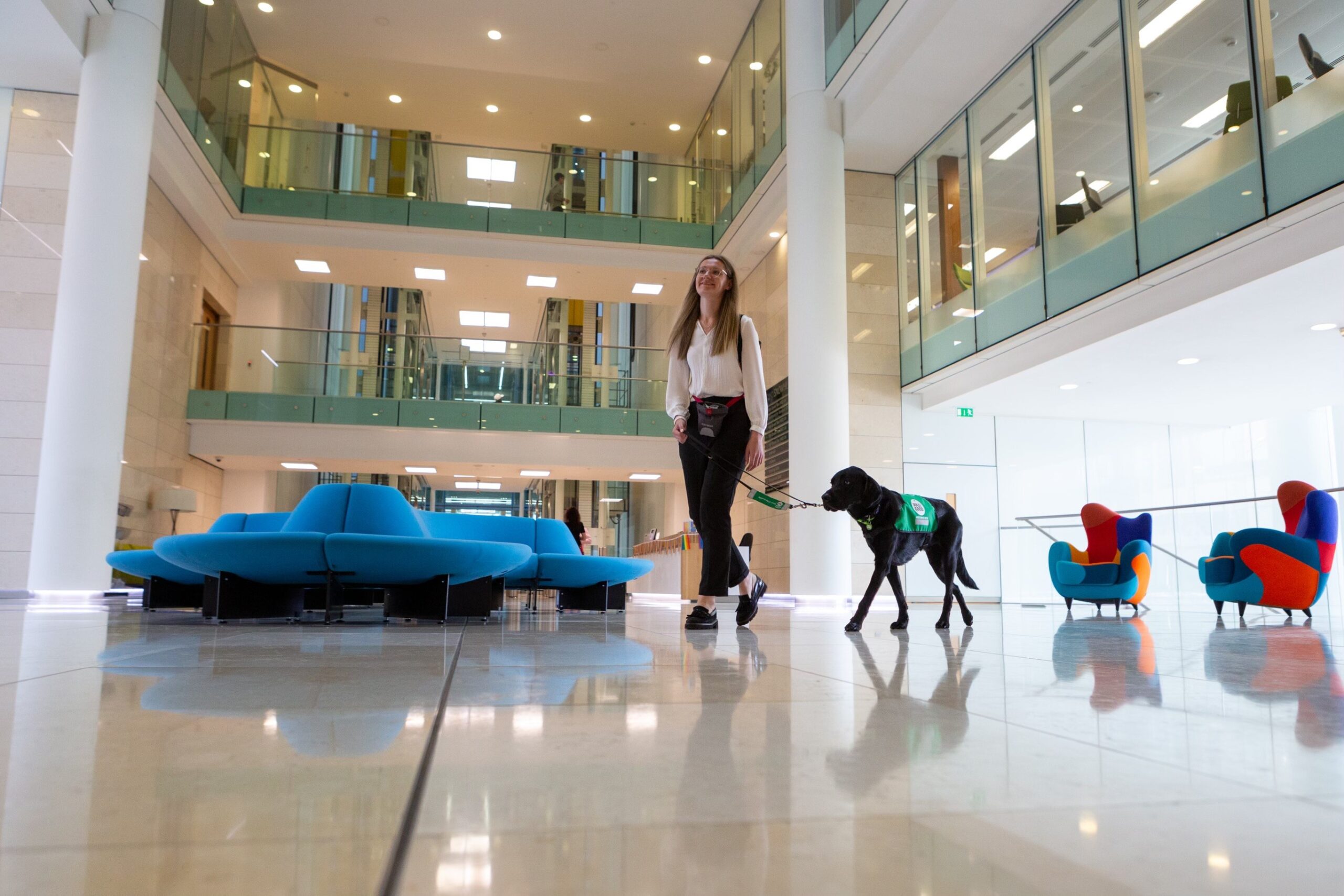
Gowling WLG were very supportive of having an assistance dog in the office. Yukimi Daule, in our HR team, was brilliant and worked with me and Dogs for Good to develop an Assistance Dog Policy. It sets out everyone’s responsibilities and it was fantastic that the firm considered all the different aspects of having an assistance dog in the office. Albert’s not a pet dog, he’s a working dog, so it’s important not to distract him when he’s working. When I take his jacket off, he knows he’s ‘off-duty’ so can say hello to people, which he loves.
What does a day in Albert’s life look like?
Albert’s day starts with one of the most important things: breakfast. He’s a typical Labrador. I take him for a walk, and then we head into Birmingham either by car or train. In the office, he helps me take my coat off by pulling the sleeves, so I don’t dislocate my shoulders. Then he’ll settle down for his morning nap. Albert comes with me around the office, if I get a coffee or go to a meeting. At lunchtime, he goes for a walk and a toilet break, then it’s time for his afternoon nap. Albert’s always ready to help me; he’ll pull doors open or pick up things I drop. He’s a much-loved member of the firm and he brings positive energy and a wagging tail to the workplace.
He has his dinner in the office, and then we head home. Albert’s a different dog at home, gone is the calm dog and it’s time for zoomies round the garden! He never fails to make me laugh with his gangly legs and cheeky character.

Image credit: Dogs for Good
What, in your view, can employers do to help remove barriers to engagement with disabled individuals?
Around 23% of the working-age population has a disability, but only around 50% of disabled people are in employment. Within the legal profession, the data is even more stark, with only 6% of solicitors declaring a disability. Employers need to be proactive and consider what changes might be necessary to enable a disabled person to join their organisation. It’s about being open-minded and flexible as many jobs can be done in different ways. Reasonable adjustments don’t have to be expensive or complicated. For example, I was repeatedly dislocating my shoulder trying to pull open a heavy door in the office. When I spoke to HR, they were about to launch into a lengthy process to turn the door into an automatic door. I asked if I could attach a rope to the door handle, and now Albert pulls it open for me. It means I’m in less pain and can focus on my work, like everyone else. It’s a quick and easy solution and Albert’s delighted because he gets a reward every time he opens the door!

Image credit: Dogs for Good
What advice would you give to other employers looking to implement similar policies?
Please be proactive in introducing reasonable adjustments like the Assistance Dog Policy. Disabled people are resourceful because we have to be. Finding an employer, like Gowling WLG, that will work with employees to problem solve to find the best way to do their job, is brilliant.
Dogs for Good has a template of the Assistance Dog Policy to share with any employer who can then tailor it to their workplace.
Through the disability network at the firm, we’ve complied a list of reasonable adjustments that people in the firm have. This can be a starting point for someone who might need an adjustment but isn’t sure what might help them. I encourage all employers to share information like this. The Business Disability Forum also has some fantastic resources for employers.
What impact has Albert made both in your work life and personal life?
Albert has changed my life, and I don’t feel terrified to leave the house now. If I drop my keys, I know Albert will pick them up and I won’t pass out in the road due to my body not being able to regulate my blood pressure; or if I take my jumper off, Albert will help me so I don’t dislocate my shoulder. He has relieved so much worry and anxiety, and he brings so much joy every day.
Albert loads and unloads the washing machine for me, which enables me to do laundry independently. It might seem like a small thing but having that independence means a lot to me (plus Albert LOVES loading and unloading the washing machine!)
On #WorldDogDay it’s great to celebrate the amazing ways that dogs can help people. The work that Dogs for Good does to train dogs like Albert is incredible and life-changing.