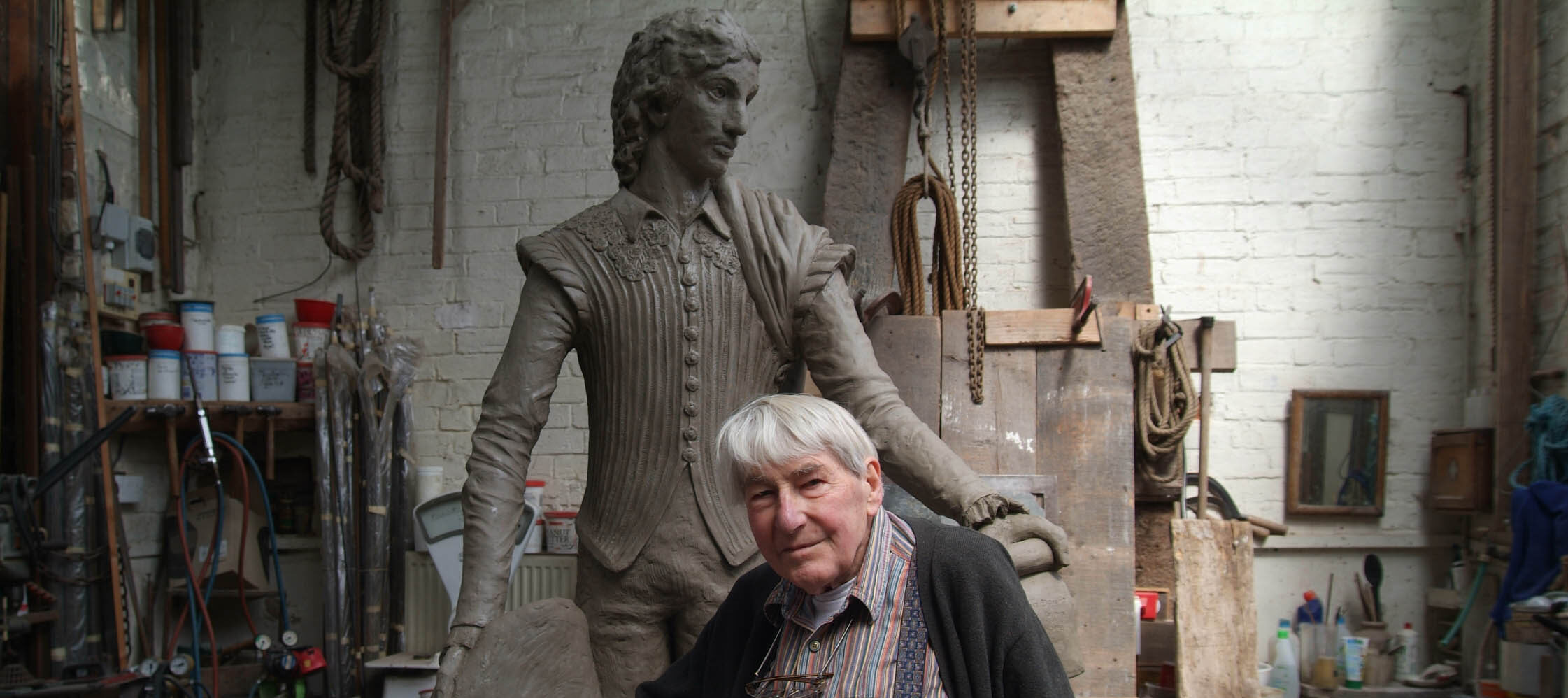
The estate of A. John Poole FRBS (1926 – 2009) will open his studio, now called The John Poole Arts and Study Centre, during Worcester Open Studios from [22 – 31 August], celebrating the life of one of Birmingham’s centrally important civic sculptors in the centenary year of his birth.
The studio, now used by Poole’s grandson, award-winning sculptor Ben Poole-Phillips, will display Poole’s sculpting tools, personal artwork and working process artefacts (including first drafts of important sculptures) from the first-ever two-time Otto Beit-winning craftsman.
The exhibition will also stage a retrospective of Poole’s working life and rarely seen photographs of the Fellow of the Royal Society of British Sculpture at work and with family. It is the first such showcase of work in 15 years.
Born in Handsworth in 1926, John Poole set up his two-floor Worcestershire studio in 1961 within the family home in Bishampton, after moving from Bournville, Birmingham.
Poole’s career spanned six decades with 450 commissions and 150 major works to his name, including 30 significant artworks that shaped Birmingham’s civic space — as well as many private commissions, including those from the Cadbury family and for Felix Dennis’ Garden of Heroes and Villains.
With such a range, the John Poole Arts and Study Centre and open studio centenary exhibition celebrates John Poole’s instructive influence on mid-century civic beautification across the West Midlands, and beyond — giving visitors the chance to view work where it was created.
His Birmingham works are varied, covering a wide range of materials and locations andinclude: –
● the Otto Beit-winning Risen Christ, welded steel, at St Dunstan’s Church, King’s Heath, Birmingham (1969).
● the Rotunda Relief, cast and coloured ciment fondu, at Grade II listed Lloyds Bank (now at Zara) (1963)
As well as, but not limited to: –
● St Catherine and St Mary, White Hollington Stone, at Solihull School (1961).
● St Francis’s Canticle to the Sun, oak carved tympanum, Church of St Francis of Assisi, Bournville (1964).
● Carved Entrance Panel at Midland Arts Centre, Cannon Hill Park (1965).
● Mother and Child, Hollington Stone, and Christus and Processional Cross (welded steel) at St Michael & All Angels Bartley Green (1965).
● Tom Bowling Memorial, carved Burlington slate stele for the site of the original Joseph Lucas Factory, for Lucas Industries (1977).
● Bronze Font on oak plinth, at St Phillips Cathedral (1982).
● Coat of Arms of George III, carved and painted limewood, at St Paul’s Church, Hockley (1996).
● Carving of the Holy Rood with St Mary and St John, painted limewood, at All Saints Church, Four Oaks (1998).
● Home Front Memorial, granite and Welsh slate, at Coventry Cathedral Ruins (2000).
The exhibition hones in on the ethos of his artistic practice — Poole would tell contemporaries and students that ‘sculpture is the intermediary between built and human form’ and would work to the material and space in front of him, rather than imposing his style on the spaces in which his work was to be located. Poole’s sculptures, therefore, were often informed by Birmingham’s materiality.
The studio will showcase Poole’s first sketches of Birmingham as an art student (he studied at Moseley Junior School of Art and Birmingham School of Art), to client boards he mocked up to win initial work, to an exclusive view of the first photos/maquette (small-scale rough draft model) of Poole’s first noteworthy commission in 1957, The Sower, a controversial granite figure for the Central Library in Cannock, Staffordshire.
The Sower made headlines after a few locals, seeing it being carved in the mason’s yard, were outraged by its nudity. Yet the quality of the sculpture, its subject and execution, played a significant role in gaining Poole’s entrance into the Royal Society of British Sculptors (now The Royal Society of Sculptors), catalysing Poole’s career.
In addition, the exhibition will show pieces vital to both Birmingham’s cityscape and that of countrywide mid-century civic and religious architecture: the towering glory of the three metre tall, wrought-steel welded Christ Proclaimant (1967), once displayed inside St. Patrick’s Church in Birmingham (and now housed in the studio), and photos of the ‘Last Supper’ Altar and Ambo carved from a single piece of Clipsam Stone for St Helens Cathedral Brentford, for which Poole won a second Otto Beit for sculpting excellence. The studio also holds the cast used to create the King Edward School Coat of Arms (1996).
There is an uncertain future for much of Poole’s architectural public art. The exhibition will show sample panels from the Rotunda relief (half-obscured in Zara in central Birmingham), alongside rare photographs, which underscores how many of his civic sculptures now risk demolition or being hidden from view, underscoring the need to value and protect this shared heritage.
The West Midlands does not have a good reputation for supporting its architectural heritage, and the estate has compiled an extensive list of Poole’s national and regional works, including those under threat.
Indeed, in the studio sits a portfolio including the reverse cast of the Royal Coat of Arms (1967) for the now-demolished Leicester Crown Court, and there are also photographs of at-risk works, including a 4,500 sq. ft concrete relief for St. John’s Precinct, Liverpool (1965), most of which has been covered over and lost to public view.
Elsewhere, the exhibition will display Poole’s tools and those of his teacher, mentor and contemporary, William Bloye. Poole was a pupil of Bloye, the head of sculpture at Birmingham School of Art and the unofficial civic sculptor of Birmingham, who worked with Raymond Forbes-Kings to sculpt the gilded bronze statue of Matthew Boulton, James Watt and William Murdoch on Broad Street.
Poole’s career was helped by initial freelance work from Bloye, and so intertwined were Bloye and Poole that Bloye bequeathed his studio contents to Poole, which include the plaster cast of ‘The Spirit of Youth’, a piece commissioned by the Cadbury workers for the Cadbury family, the bronze cast of which is located outside the Cadbury Factory.
Also, in the studio sits a one-of-one maquette Bloye made of his girlfriend, which he later defaced when they parted; Poole later restored the figure, reinstating her missing face.
The exhibition will also showcase personal, never-seen-before works and private commissions; models of unexecuted works, such as a study for a proposed new stone sculpture of a bishop for the west front of Wells Cathedral and a Christ figure for Liverpool Cathedral; several marble torsos; an early political sketch, from when Poole was a member of the Young Communist League, and a carved wooden seat, affectionately known as ‘bottom’, which he used to delight in showing off to such visitors as members of the Women’s Institute, telling them, with mischievous delight, that ‘he only worked from real life!’’.
There will also be unpublished photos of Poole’s rich working life—including those from his last year, when he was still employed on his final major sculptural commission, John Donne, for Felix Dennis’s Garden of Heroes and Villains.
There is increased interest in mid-century public sculpture, including the works of Poole, as a more nuanced understanding of the period evolves and becomes less reliant on dominant names such as Henry Moore and Barbara Hepworth, and as campaigners work to preserve and remember a civic past often under threat of destruction, or already destroyed. Indeed, Poole’s works at St John’s Precinct Liverpool and Hednesford Library can only be seen in photographs housed in the studio.
The John Poole Arts and Study Centre is still a working studio for Poole’s grandson, Ben Poole-Phillips, who exhibited earlier this year at The Fresh Air Sculpture Show and won the Henley Arts RISE Sculptor Award. Ben has previously worked as a finishing assistant for Sir Anthony Gormley and at Arch Bronze Foundry, where he developed valuable casting and metalworking skills. He continues and revitalises his grandfather’s sculptural legacy through nature-inspired stone carvings and bird iconography that explore mythology and prehistory, using both his grandfather’s and William Bloye’s tools.
John Poole’s work can be found all over the UK, with a concentration in the Midlands — an interactive map shows where his public works can be found across the country.
Victoria Poole, architect and John Poole’s daughter, has said:
“It has been frustrating that the inspirational work of so many talented late 20th-century British sculptors has been underappreciated for far too long.
“This retrospective of my father’s award-winning work in his centennial year wonderfully aligns with the growing recognition of the wider contribution of so much beautiful post-war art to our cultural heritage.”
Viv Astling OBE Hon., Sculptor and Vice President of Royal Birmingham Society of Artists Trustees has said:
“That John Poole won the national Otto Beit Prize for Excellence in Sculpture twice, a unique feat for that prestigious prize, tells you much about the quality of his work.
“Much of his work is in Birmingham and the West Midlands, which the Royal Birmingham Society of Artists recognised by granting him the rare honour of Honorary Membership. Poole is undoubtedly an important sculptural figure in the 20th century whose contribution to public art and sculpture should receive greater appreciation by a wider audience.”
Professor Carl Chinn MBE, historian, author and West Midlands social campaigner, has said:
“Birmingham does not seem to be good at honouring its own distinguished sons and daughters in their lifetimes. But John Poole deserves the highest honours: a most important Birmingham sculptor whose work is found across the city.
“John’s motto was Non Omnia Moriar, a Latin saying meaning ‘Not all of me will die’. Thanks to his work, and work undertaken around the centenary of his birth, this most talented man should live on.”
Catherine Croft, director of The Twentieth Century Society, has said:
“The work of John Poole deserves to be better known and appreciated — there would be no better way to celebrate his centenary than by uncovering his magnificent Rotunda Relief.”
Philomena Davidson PPRSS RWA, past president of the Royal Society of Sculptors, has said:
“John Poole was a kind and very knowledgeable gentleman. Along with a number of other members of the Royal Society of Sculptors, John had been to war.
“On their return, this particular generation of very able men and women managed to reinvent themselves and build on their good fortune to have survived the war by leading productive, creative and eventful lives. John’s highly successful career stands out as an excellent example of this.”